
Arriving in South Korea: visa-free stays, K-ETA and the e-Arrival card
Most visitors can arrive in South Korea without a visa. Some nationalities need an online travel authorisation, the K-ETA, before they fly, and almost everyone else fills in an arrival card, now usually online. Both are free or cheap on the official sites, so ignore the lookalike websites that charge more.
Do you need a visa?
- Visa-free stays: passport holders from more than a hundred countries can visit South Korea for tourism without a visa. For most, including the UK, Ireland, the USA, Australia, New Zealand, Japan and most of the European Union, the limit is 90 days. Canadians can stay up to six months, and some nationalities get 30 or 60 days. Check the K-ETA site's list of eligible countries, or the nearest Korean embassy, for yours.
- Everyone else, and anyone who wants to work or study, needs a visa from a Korean embassy or consulate before travelling. You can't work on a visa-free entry.
- Your passport must be valid for the whole of your stay. Some airlines ask for six months, so it's safest to have that.
- You should have a ticket out of Korea: immigration and airlines can ask for it.
The K-ETA
The K-ETA (Korea Electronic Travel Authorization) is an online permission to travel that visa-free visitors apply for before they board a plane or ship to Korea.
- Who is exempt for now: passport holders from 22 countries and territories don't need one, under a temporary exemption. They include the UK, the USA, Canada, Australia, New Zealand, Japan, Singapore, Germany, France, Italy, Spain, the Netherlands, Belgium, Austria, Poland, the Nordic countries, Taiwan, Hong Kong and Macau. The exemption has been extended a year at a time: on 23 November 2026 Korea announced that it now runs until 31 December 2027. Check the notices on the K-ETA site before you travel, as it may change.
- Also exempt: travellers aged 17 or under, or 65 or over, on the day they arrive, as well as people with a Korean visa or residence card.
- Everyone else who travels visa-free needs a K-ETA. Apply only on the official site, k-eta.go.kr, or its official app. It costs 10,000 won plus a card fee of about 3%, and isn't refunded if you're refused. Apply at least three days before you fly: most are decided within 72 hours, but it can take longer, and there's no fast-track service.
- A K-ETA is valid for three years, or until your passport expires if that's sooner, for any number of visits. You need a new one if you get a new passport.
- Exempt travellers can still apply if they want to, and pay the fee: the advantage is that K-ETA holders don't need to fill in an arrival card.
The e-Arrival card
- Visitors who don't have a K-ETA, including everyone on the temporary exemption, must give immigration an arrival card. The quickest way is the free online e-Arrival card on e-arrivalcard.go.kr, which you can fill in up to three days (72 hours) before you arrive. It asks for your passport, flight and where you're staying.
- Paper arrival cards were still available at the time of writing, but they're being phased out, so do it online if you can.
- If you have symptoms of an infectious disease, you also need to fill in a health declaration, online through Q-CODE or on paper, when you arrive. Korea can fine people who don't.
Customs
- Declare cash and other money worth more than US$10,000, and anything that may be taxable or prohibited.
- Don't bring in drugs of any kind, including cannabis or CBD products that are legal at home. Korea tests people and prosecutes them: see Safety and laws.
- Bring only small amounts of medicine for yourself, in your hand luggage, in its original packaging, with an English prescription or doctor's letter. Some medicines need permission in advance: see Health.
- Fresh fruit, meat and other farm products are tightly controlled. Don't bring them.
Arriving at Incheon
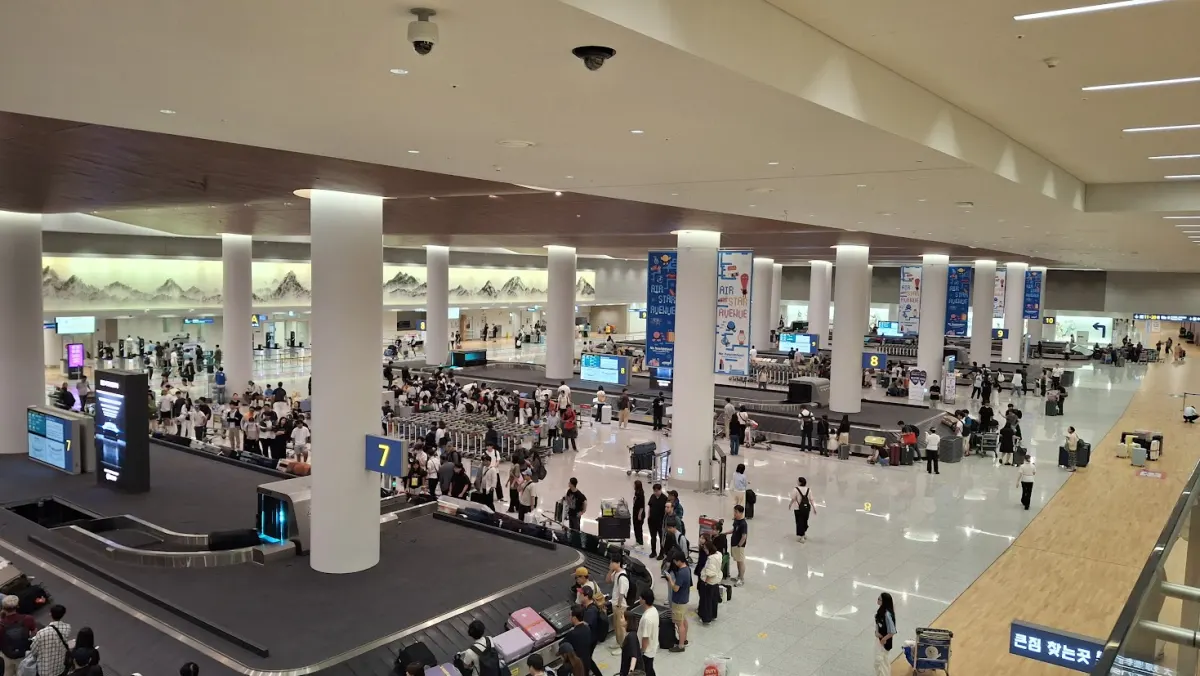
- Most international flights land at Incheon International Airport, on an island west of Seoul. It has two terminals, far apart: check which one your airline uses when you fly home. Some flights from nearby countries use Seoul's smaller Gimpo airport, which is closer to the city, and there are international flights into Busan (Gimhae), Jeju and a few other cities.
- The AREX airport railway runs from both terminals to Seoul Station, in under an hour. The all-stops train is cheaper and connects with the subway; the express is non-stop. You can pay with a T-money card: see Getting around Seoul.
- Airport limousine buses, which are comfortable coaches despite the name, go from outside arrivals to the main areas of Seoul and to other cities, and are easier with heavy bags.
- Use the official taxi rank, or a taxi app, rather than anyone offering a ride in the arrivals hall.
- Get a SIM card or eSIM, and a T-money card, at the airport before you head into the city: see Phones and apps.
See also: Money in South Korea and Trains and buses between cities.



Comments
No comments yet.