
Getting around Seoul and other Korean cities: the subway, T-money, buses and taxis
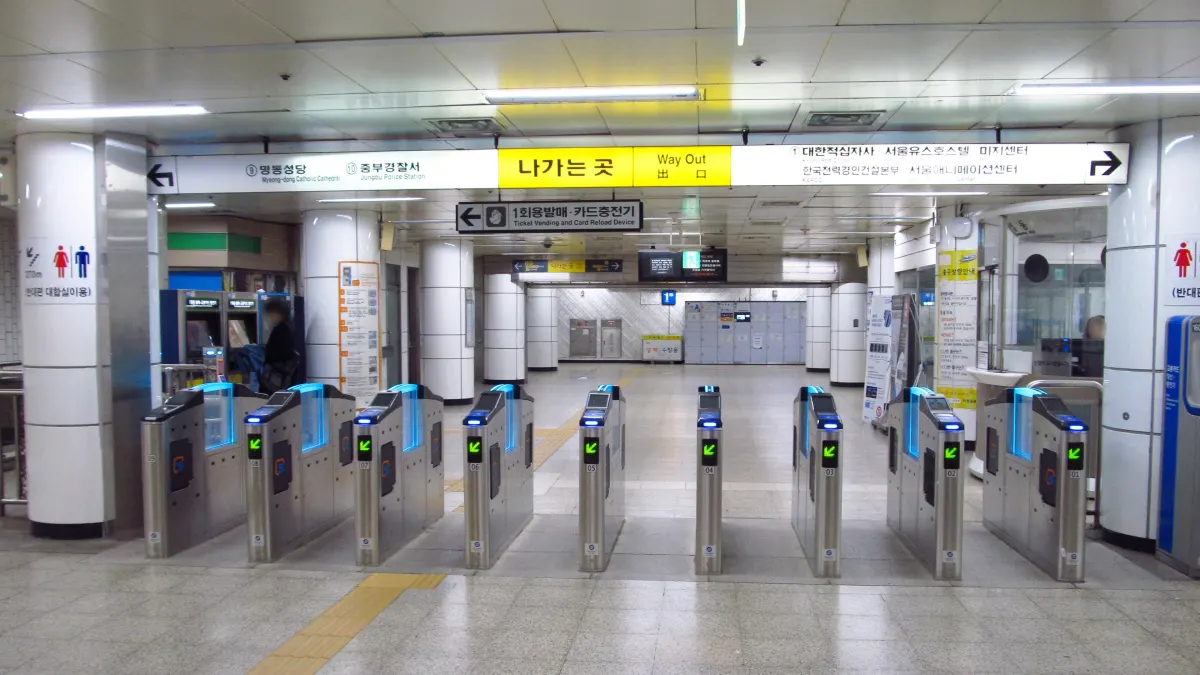
Seoul's subway is one of the best in the world: clean, cheap, signposted in English, and it goes almost everywhere. Busan, Daegu, Daejeon and Gwangju have their own subways, and buses fill in the rest. A T-money card works on almost all of them.
T-money cards
- T-money is a rechargeable card that you tap on the subway, buses, and taxis all over the country, and in convenience stores. Buy one at a convenience store (GS25, CU, 7-Eleven) or in a subway station, for a few thousand won, then top it up.
- Top up at machines in subway stations, or at a convenience store counter. Machines take cash, and some take cards; convenience stores usually want cash.
- Tap in and tap out on buses as well as the subway: the fare depends on the distance, and you lose the transfer discount if you don't tap out.
- You get a free or cheap transfer between the subway and buses if you tap on again within 30 minutes of getting off (an hour late at night), up to four times.
- Prepaid cards for visitors, such as WOWPASS, combine a T-money card with a card you can pay with in shops.
- Single-journey tickets for the subway exist too, but cost more and need a deposit: a T-money card is easier.
Seoul's Climate Card
Seoul's Climate Card (Climate Card in English, Gihu Donghaeng Card in Korean) gives unlimited rides on Seoul's subway and buses for a set number of days. The short-term passes for visitors cost 5,000 won for 1 day, 8,000 for 2, 10,000 for 3, 15,000 for 5 and 20,000 for 7, plus 3,000 won for the card, at the time of writing. It covers Seoul's subway lines and city buses, but not some lines that go outside Seoul (such as the Sinbundang line), airport buses or express buses, and it only takes you to Incheon Airport, not from it. It's worth it if you take more than three or four trips a day.
The subway
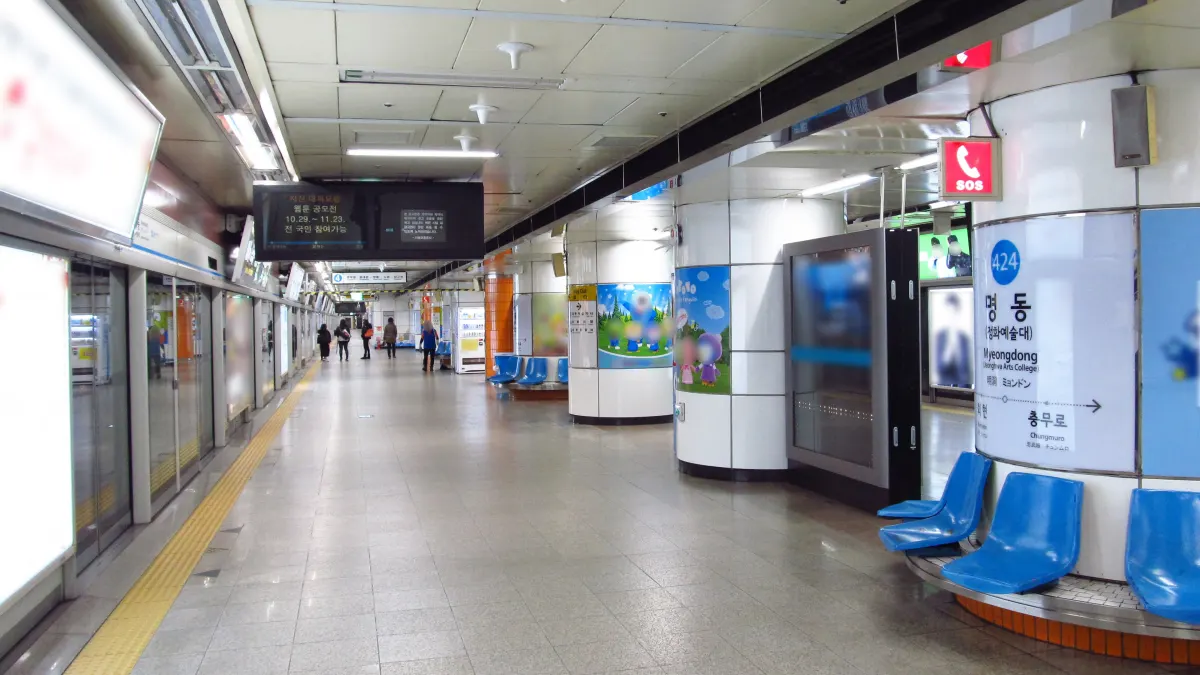
- Every line has a colour and a number, and every station has a number. Station names and announcements are in English as well as Korean, and maps show which exit to use for which places: exits are numbered, and directions in Korea are usually given as "station, exit 3".
- Trains run from about 5.30am to about midnight or a little after. Late at night, use the night buses or a taxi.
- The seats at the ends of each car are for older people, disabled people and pregnant women, and the pink seats are for pregnant women: leave them empty even if the train is crowded.
- Talk quietly, and don't eat on the subway.
Buses
City buses are colour-coded in Seoul: blue buses run along main roads across the city, green buses connect to subway stations, and red buses go to the suburbs. Naver Map and KakaoMap show which bus to take and when it's coming: see Phones and apps. Tap your card when you get on, and again when you get off by the back door. Drivers often pull away fast, so hold on.
Taxis
- Taxis are cheap and plentiful. Regular taxis are usually orange, silver or white; black "deluxe" (mobeom) taxis cost more. All use a meter, and charge more late at night. You can pay by card or T-money, and you don't tip.
- Drivers rarely speak English, so show them the address or name in Korean on your phone.
- Kakao T is the main taxi app, and Kakao Mobility's k.ride app is made for foreign visitors, in English and other languages, without a Korean phone number. Registering a foreign card in Kakao T doesn't always work: choose to pay the driver instead if it fails. Uber also works in Seoul, mostly booking ordinary taxis.
- At the airport and at busy places, use the official taxi ranks. If a driver won't use the meter, take another taxi.
Other cities
Busan's subway runs from the main train station to Haeundae, Seomyeon and the old port, and Busan also has a light railway and buses to Gimhae airport. In Jeju, Gyeongju and smaller cities, you'll use buses, taxis or a hire car. T-money works everywhere, and so do the map apps.
Bikes
Seoul's public bikes, Ttareungyi, can be hired in an app, and there are long, flat cycle paths along the Han River. Electric scooters are everywhere too, but the law requires a driving licence and a helmet, and riding on the pavement is banned.
See also: Trains and buses between cities and Arriving at Incheon.
Comments
No comments yet.