
Laws and customs in Saudi Arabia: photos, social media, alcohol, drugs, dress, relationships and Ramadan
Saudi Arabia has relaxed a great deal since it opened to tourists in 2019, and people are famously hospitable. But its laws are strict, the penalties are heavy, and the war has made the police much more sensitive about cameras and phones. Many governments advise against travel at the moment: read the travel warnings first.
Photos and filming
- Never film or photograph attacks, interceptions, smoke, debris or damage, or share pictures of them, not even in a private message. The Interior Ministry says it exposes you to legal liability, and the US embassy says that Americans have been detained for this and for photos of government buildings and airports.
- Don't photograph government buildings, embassies, palaces, military or police sites, airports, ports, or oil and power plants.
- Ask before you photograph people, and don't photograph women or families without clear permission. Posting someone's picture without their consent can bring a fine or prison, says Germany.
- Germany says that filming and photography are expressly forbidden in and around the two holy mosques in Makkah and Madinah. If you go there, ask about the rule and follow the signs.
What you say and post
- It's a crime to criticise or mock the King, the Crown Prince, the royal family, the government, Islam or Saudi society, or to say anything judged to disturb public order. The UK also lists the situation in Israel and Palestine.
- This covers posts, shares and even likes, including ones made years ago in another country. Foreigners have been sentenced to long prison terms for tweets.
- Australia says that negative reviews that harm the reputation of tourism can be an offence, as can collecting for charity online or posting paid adverts without a licence.
- Journalism and any public filming or publishing need permission in advance. Protests are illegal.
- Don't wear or carry political slogans, flags or symbols, least of all on a pilgrimage.
Alcohol and drugs
- Alcohol is illegal to bring in, buy, carry or drink for visitors. Reports say that a small number of shops now sell it to diplomats and some wealthy non-Muslim residents: tourists can't use them. Being drunk in public can mean prison and deportation.
- Drugs: no tolerance at all. The UK says up to five years in prison and a 30,000-riyal fine for possessing even a small amount, and a death sentence is possible for dealing or smuggling. Australia adds that you can be held just for being with someone who's involved.
Dress
- Both men and women should wear loose clothes that cover the shoulders and the knees (the UK says the elbows too). Nothing tight or see-through, and no offensive words or pictures.
- Women who visit don't have to wear an abaya or cover their hair, though many find that an abaya makes life easier in conservative places. You need to cover your hair in a mosque.
- Men should avoid shorts above the knee in town, and going shirtless anywhere but a private beach or pool.
Public behaviour
- The public decency rules carry on-the-spot fines, reported as 50 to 6,000 riyals, for things like improper clothes, littering, loud music at prayer times, jumping queues, and photographing people without permission.
- No kissing or embracing in public, no swearing or rude gestures, and no shouting in an argument.
- Some shops and offices still close for a short while at prayer times, above all on Friday at midday. The weekend is Friday and Saturday.
- Unwanted approaches to a Saudi woman by a foreign man can be reported as harassment, even without any touching, says Germany.
Relationships
- Sex outside marriage is illegal, for visitors too. The UK says that unmarried tourists may share a hotel room.
- Pregnancy outside marriage can lead to arrest. Germany strongly advises unmarried women not to give birth in the country.
- Same-sex relations are illegal, with severe penalties on paper, and being transgender isn't recognised. The tourism authority says that all visitors are welcome and won't be asked about their private life, but discretion is essential for everyone.
Religion
- Practising any religion but Islam in public, showing its symbols, and trying to convert anyone are all illegal. Private worship is tolerated.
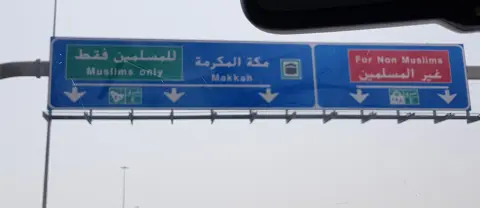
- Non-Muslims can't enter Makkah, or the area of the Prophet's Mosque in Madinah: see Entering Saudi Arabia.
Ramadan and Eid
- Ramadan is expected from about 8 February to 9 March 2027, and Hajj from about 14 to 19 May 2027, with Eid al-Adha in the middle of it. Dates depend on the sighting of the moon.
- In Ramadan don't eat, drink, smoke or chew gum in public in daylight, or in your car. Many restaurants close by day. Offices work shorter hours, roads are dangerous just before sunset, and the evenings are lively.
- At both Eids, many businesses close for several days, and transport and hotels fill up.
The police and the courts
- Carry your passport or a copy, and your visa: you can be fined or held without ID.
- You can be held without charge during an investigation, and your embassy may not be told or allowed in for some time. Ask for it to be told.
- Travel bans stop people from leaving over debts, accidents, family disputes and court cases, sometimes for years.
Manners
- Greet people with as-salamu alaykum. Wait for someone of the opposite sex to offer a hand first; a hand on the heart is a polite alternative.
- Use your right hand to eat, give and take. Take your shoes off in homes and mosques, and don't show the soles of your feet.
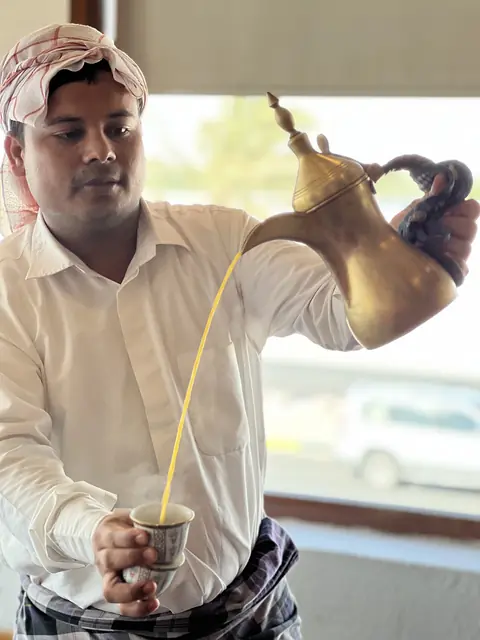
- If you're offered Saudi coffee and dates, accept at least one cup, and give the cup a little shake when you've had enough. A shared platter of kabsa is eaten from the part in front of you.
- Don't ask after a man's wife or other women in his family unless you know them.
Food and drink
Saudi coffee and dates
Riyadh
Arabic coffee (qahwa), light-roasted with cardamom, sometimes saffron, poured from a dallah pot into small cups and served with dates, is the sign of…

Comments
No comments yet.