
Arriving in Hong Kong: visa-free stays, e-Channel, the airport, and what not to bring
Most visitors from Europe, North America, Australia and New Zealand can visit Hong Kong without a visa, for between 90 and 180 days. There's no arrival card to fill in any more, the airport is one of the easiest in the world to get out of, and the only things that catch many visitors out are vapes and cigarettes in their luggage.
Do you need a visa?
Hong Kong is part of China, but it has its own immigration rules, separate from the mainland's: a visa for mainland China isn't valid for Hong Kong, and you don't need one to visit Hong Kong. The Immigration Department's list (updated in 2026) gives visa-free stays for tourists of:
- 180 days: British citizens.
- 90 days: the USA, Canada, Australia, New Zealand, Ireland, Germany, France and most of the rest of Europe, and many other countries.
- 14 days: India, but Indian passport holders have to complete the free online pre-arrival registration before they travel.
- Other nationalities have shorter visa-free stays or need a visa. Check the Immigration Department's list at immd.gov.hk.
- Your passport should be valid for at least a month after you leave (the UK government's advice for British visitors), and many airlines expect six months, so that's safest. A passport that has been reported lost or stolen will be refused.
- You may be asked to show you have enough money for your stay and a return or onward ticket. You can't work or study on a visitor's stay.
- Each time you come back from Macau or mainland China, you're given a new visa-free stay at the border. Many visitors go in and out several times on one trip. See Crossing to Shenzhen, mainland China and Macau.
No arrival card
Hong Kong stopped asking visitors to fill in arrival and departure cards in October 2024. At the immigration counter, the officer stamps nothing in your passport: you're given a small paper landing slip with your name and how long you can stay. Keep it with your passport until you leave, as hotels sometimes ask to see it.
The e-Channel gates
- Hong Kong's automated e-Channel gates are mostly for residents, but some visitors can use them after enrolling (free): adult passport holders from countries with an agreement with Hong Kong, including Australia, Germany and South Korea, and some from Singapore and Thailand. Frequent visitors aged 18 or over who meet other conditions can enrol too.
- Since 2026, eligible visitors can enrol on their phone before they arrive with the Immigration Department's Go Hong Kong app, instead of at an enrolment office. Enrolment lasts two years, and is extended each time you visit.
- Many visitors with an electronic passport can use the e-Channel gates when they leave without enrolling (Smart Departure). See the Immigration Department's e-Channel page for who can use what.
- Everyone else uses the visitors' counters, which are usually quick at the airport.
What not to bring
- No vapes. Bringing e-cigarettes, heated tobacco products, herbal cigarettes or their devices into Hong Kong is banned, including in your luggage, and since 30 April 2026, it's also an offence to carry them in any public place, even if you're not using them. Visitors are fined too: there's a fixed penalty of HK$3,000 for small amounts, and more than that can mean a fine of up to HK$50,000 and prison. Transit passengers who don't pass through immigration are exempt. Leave them at home.
- Cigarettes: the duty-free allowance is only 19 cigarettes (or 1 cigar, or 25 g of tobacco), not a carton. Declare anything over that at the red channel and pay the duty: the fines for not declaring are high.
- Alcohol: you can bring 1 litre of spirits duty-free.
- Drugs: all cannabis products are illegal in Hong Kong, including CBD oils, sweets and cosmetics that are legal at home. Penalties for drug offences are severe, including for passengers in transit. See Safety and the law.
- Weapons: stun guns, knuckledusters, swords and some knives are banned, even as souvenirs.
- Medicines: bring only what you need for your trip, in the original packs, with a prescription or a letter from your doctor.
- Money: you must declare cash and bearer cheques worth more than HK$120,000 when you arrive.
- Baby formula: this is about leaving, not arriving. Hong Kong limits how much powdered formula you can take out of Hong Kong (to stop it being resold in mainland China): take only what your own baby needs.
From the airport into town
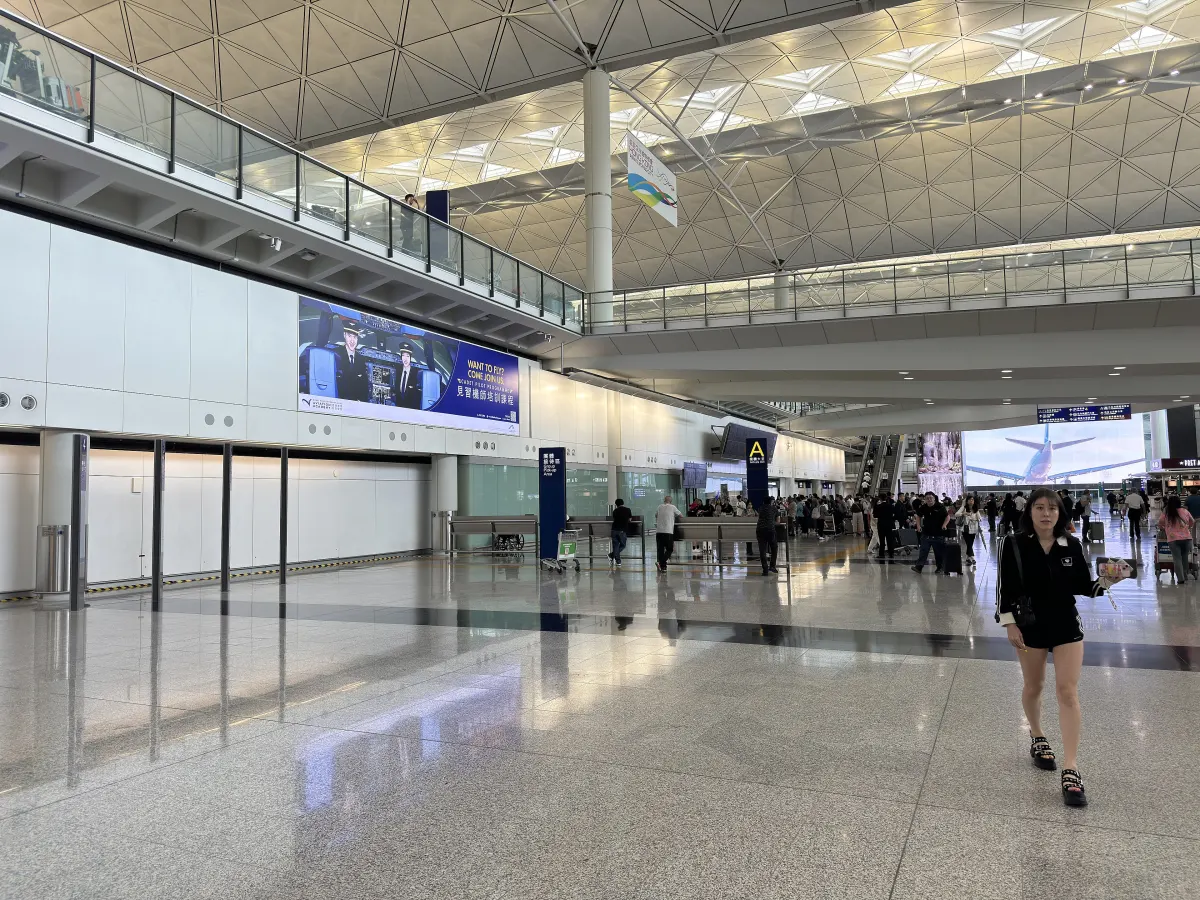
- Hong Kong International Airport is on an island next to Lantau, about 35 km west of Central.
- The Airport Express train is the quickest way into town: it runs about every 10 minutes and takes about 24 minutes to Hong Kong station in Central, with stops at Tsing Yi and Kowloon. Since May 2026, you can pay by tapping a contactless Visa, Mastercard or UnionPay card at the gates, or with an Octopus card, or buy a ticket at the machines and counters. Free shuttle buses run from Kowloon and Hong Kong stations to many hotels.
- Airport buses (the "A" routes, such as the A21 to Tsim Sha Tsui and Mong Kok and the A11 to Central and Causeway Bay) take longer but cost much less, and stop near many hotels. There are night buses after the trains stop.
- Taxis wait outside arrivals. Red taxis go anywhere in town, green taxis serve the New Territories and blue taxis Lantau. See Getting around Hong Kong.
- Get an Octopus card at the airport (at the Airport Express counters or a convenience store) or set up the Octopus app before you fly. See Getting around Hong Kong.
- Going straight to Macau or Zhuhai? Buses over the Hong Kong–Zhuhai–Macao Bridge leave from the Hong Kong Port, next to the airport. See Crossing to Macau and mainland China.
Before you go
- Check your government's travel advice, and read about the national security laws: see Safety and the law in Hong Kong.
- Get travel insurance with medical cover: healthcare in Hong Kong is excellent, but expensive for visitors. See Weather, heat and health.
- Sort out your phone: see Phones and apps for Hong Kong.
- Hong Kong uses UK-style three-pin plugs (type G), at 220 volts.

Comments
No comments yet.