
Taking the train in China: booking, seats and stations
China's trains are fast, clean and on time, and often the best way between cities. Here's how to book, which seat to choose, and how to find your train at the station.
Booking
- Railway 12306 (铁路12306), China Railway's own website and app, has an English version. Register with your name exactly as it is in your passport, and do it well before you travel, as checking your passport can take a few days. You can pay with a foreign card such as Visa or Mastercard, or with Alipay or WeChat Pay, and there's no booking fee.
- Trip.com is easier for many visitors, in English with foreign cards, but charges a small fee per ticket.
- At the station: buy at the ticket office (售票处) with your passport. Many ticket machines only take Chinese ID cards.
Tickets go on sale 15 days before the train, and you can book up to the day. Popular trains, such as Beijing to Shanghai at weekends, and anything around Chinese New Year and the first week of October, sell out fast, so book as soon as you can. If a train is full, 12306 lets you join a waiting list (候补), which often works.
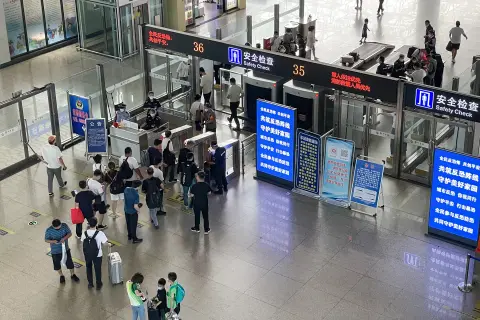
Your ticket is linked to your passport, and you use the passport to get in. See Security checks, ID and banned items on China's public transport for what to expect at the station.
Which train
The letter before the train number tells you what kind of train it is:
- G: high-speed, up to 350 km/h, between big cities.
- D: high-speed, a bit slower, and some overnight sleeper trains.
- C: high-speed trains between nearby cities.
- Z, T, K and trains with only a number: older, slower trains, often overnight, and much cheaper.
Which seat
- Second class (二等座): rows of five seats (3+2), comfortable and good value. Most people travel this way.
- First class (一等座): rows of four (2+2), with more room.
- Business class (商务座): reclining seats, three or two to a row, with snacks. Much more expensive.
- Soft sleeper (软卧): a cabin of four beds with a door, on overnight trains.
- Hard sleeper (硬卧): open sections of six beds. The lower bed costs most and the top one least, with little headroom.
- Hard seat (硬座) on slow trains: cheap but crowded on long trips. No seat (无座) means standing.
On 12306 you can pick a seat letter: A and F are by the window, and in second class C and D are on the aisle.
At the station
- Many cities have several stations, such as Beijing South and Beijing West, so check which one your train leaves from. High-speed stations are often outside the centre, but on the metro.
- Allow about an hour: you'll queue for the ID check and security, and big stations are huge.
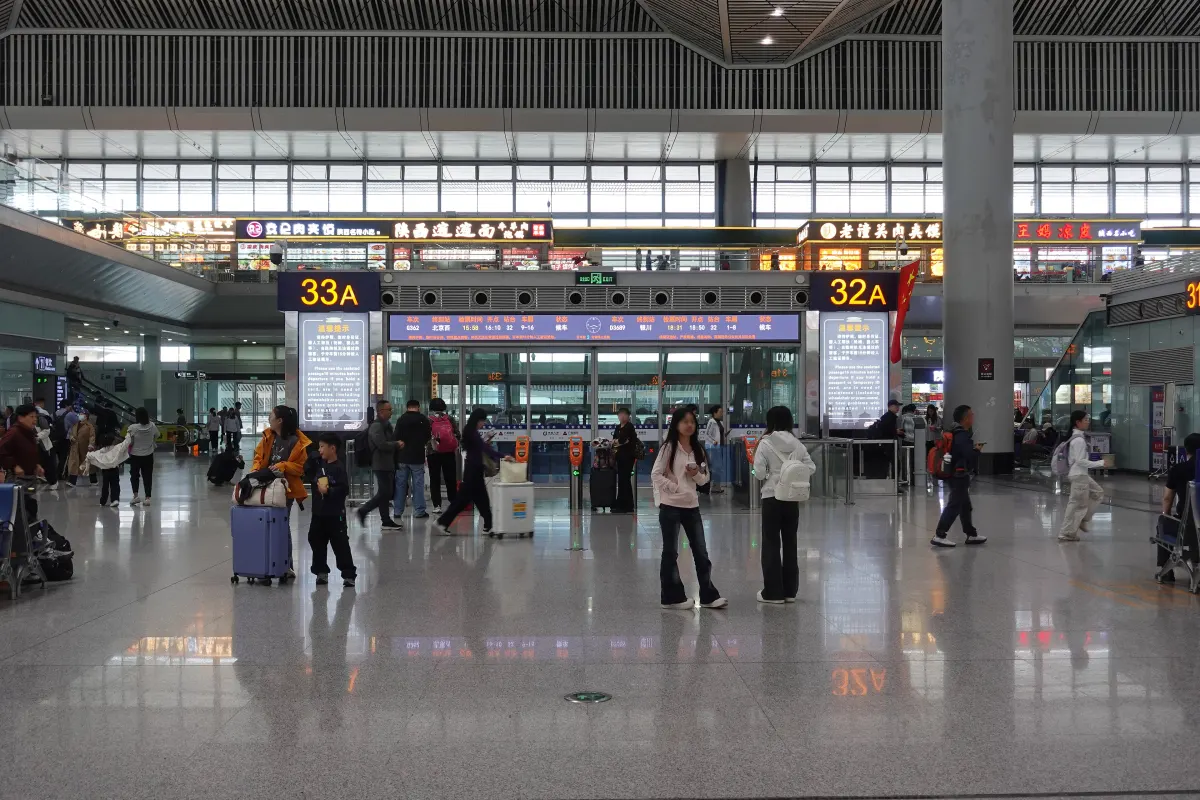
- The departure boards show your train number, the waiting area and the gate (检票口). Boarding starts about 15 to 20 minutes before the train leaves, and gates close a few minutes before.
- On the platform, the ground is marked with carriage numbers. Stand by yours: trains stop for only a minute or two at many stations.
- Keep your passport handy, as you'll need it again to leave the station at the other end.
On board
- There's hot water on every train, so bring tea or instant noodles if you like. There's a food trolley and often a dining car, and on many high-speed trains you can order a meal to your seat in the 12306 app.
- Luggage goes on the racks above the seats, or in the space at the end of the carriage. Big suitcases can be hard to fit on busy trains.
- Smoking, including e-cigarettes, isn't allowed on high-speed trains, and keep phone calls short and quiet.
Changes and refunds
- You can change a ticket once, usually free if you change to another train on the same day or earlier.
- Refunds cost nothing 8 days or more before the train, then 5% of the fare up to 48 hours before, 10% from 48 to 24 hours, and 20% in the last 24 hours. Bought the wrong ticket? On 12306 you can usually refund it free within 30 minutes of buying.
- If you booked through Trip.com or an agent, its own rules and fees may apply too.

Comments
No comments yet.