
Security checks, ID and banned items on China's public transport
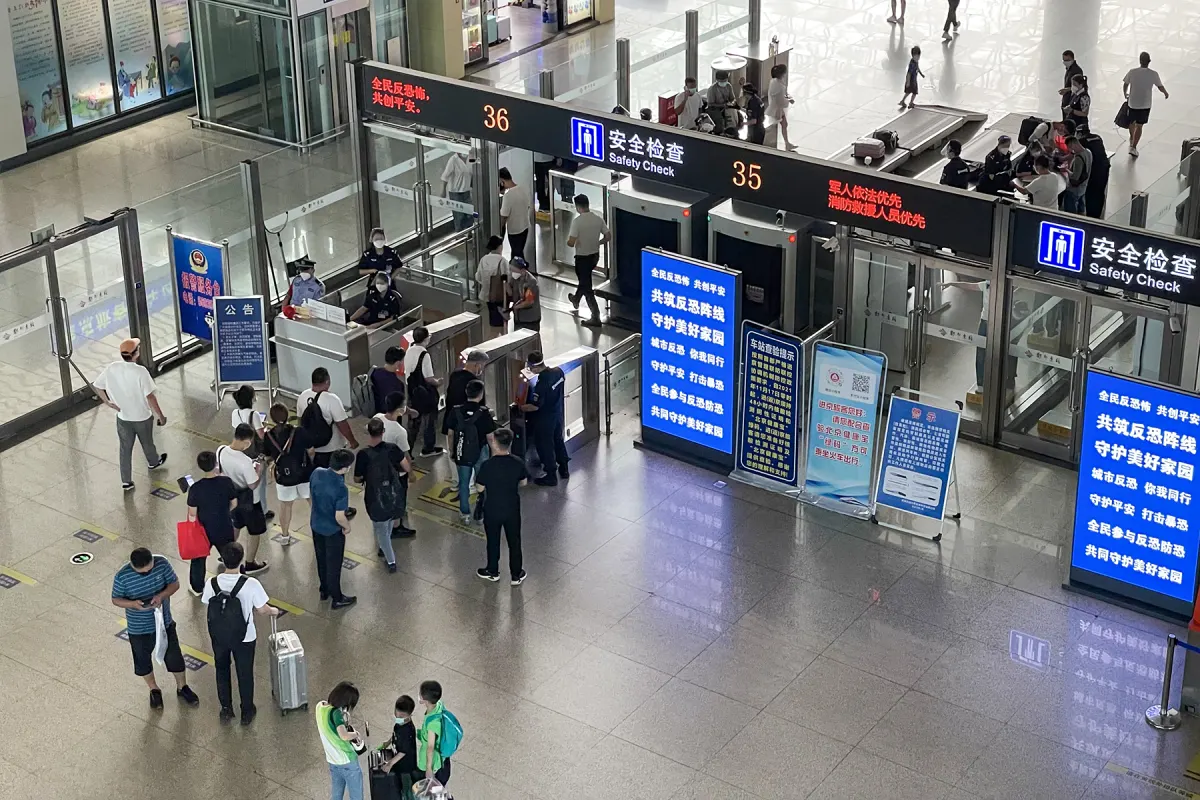
Metro stations, railway stations, long-distance bus stations and airports in mainland China all have airport-style security checks. Here's what to expect, why you need your passport, and what to leave at home.
The security check
At the entrance, before the ticket gates, you put your bags (and anything else you're carrying, such as a coat or shopping) on the belt of an X-ray machine. You then walk through a metal detector or stand while a guard passes a hand-held detector over you. Drinks may be checked too: staff may scan the bottle or ask you to take a sip.
- Metro: every station, every trip. It usually takes less than a minute, but at rush hour there can be a queue at busy stations. You can't get to the trains without going through it.
- Railway stations: your ticket and passport are checked first, then you go through security to reach the waiting halls. Big stations are busy and the walk to your gate can be long, so allow about an hour before departure, and more around public holidays such as Chinese New Year and the first week of October. Boarding gates close a few minutes before the train leaves.
- Airports: your passport and boarding pass are checked, then after the walk-through detector everyone is checked with a hand-held one too. Take laptops, tablets and power banks out of your bag for the X-ray.
- Long-distance bus stations: bags go through an X-ray machine before you reach the buses.
Anything not allowed is taken from you at the check, and you usually can't get it back. Some airports, such as Beijing Capital, will keep items for you or post them on, but don't count on it.
ID: always carry your passport
Train tickets in China are in your name. Each one is linked to the ID it was bought with, and for foreign visitors that's your passport. Book with the passport you'll travel on: on the official China Railway 12306 website or app, through an agent, or at a station ticket office (take your passport with you).
- There's usually no paper ticket: your passport is your ticket. It's checked at the station entrance, at the boarding gate, sometimes on the train, and at the exit gate at the other end.
- Some automatic gates read passports, but many only take Chinese ID cards. If yours won't, use the staffed lane (人工通道).
- Long-distance bus tickets are in your name too, and need your passport to buy and to board.
- Flights need your passport at check-in and security, as anywhere.
- The metro and city buses don't need any ID. Pay with a transport card, a ticket from the machine, or a QR code in Alipay or WeChat.
Foreign visitors over 16 must carry their passport (or residence permit) in China, and hotels need it to check you in, so keep it on you, somewhere safe and easy to reach.
What you can't take on a train
These are China Railway's rules, in force since 1 July 2022.
Not allowed at all
- Fireworks and firecrackers (including cold sparklers), explosives and flares.
- Fuel and other flammable liquids and gases: petrol, kerosene, diesel, methylated spirits, lighter fluid, gas canisters.
- Guns of any kind, including replicas, and controlled knives such as daggers and flick knives.
- Poisons and strong pesticides, corrosive or radioactive things, mercury, and wet batteries.
- Spirits over 70% alcohol, or with no clear label.
Not with you, but can be sent as luggage
- Kitchen knives, fruit knives, scissors, craft knives and other everyday blades longer than 60 mm (6 cm). Shorter ones can go with you.
- Bats, clubs and cues; tools such as saws, axes and drills; bows, darts and slingshots; self-defence spray (up to 50 ml).
Allowed in limited amounts
- Lighters and matches: up to two ordinary lighters and two small boxes of safety matches.
- Power banks and spare lithium batteries: each up to 100 Wh (about 27,000 mAh), with the capacity clearly marked on them.
- Alcohol: drinks of 24% to 70% alcohol must be in sealed, labelled bottles, up to 3 litres in all.
- Sprays (hairspray, mousse, sunscreen spray): up to 150 ml a can, one of each kind, and no more than 600 ml in all.
- Perfume, mosquito repellent and hand sanitiser gel: up to 100 ml a bottle, one of each kind.
- Nail polish and nail polish remover: up to 50 ml in all.
Pets can't travel with you in the carriage (guide dogs can). Smoking, including e-cigarettes, isn't allowed on high-speed trains: it sets off the smoke detectors, and you'll be fined.
On the metro
Each city sets its own metro rules, but they all ban anything flammable, explosive, poisonous or corrosive, and guns and dangerous knives. A good rule is that anything you can't take on a train, you can't take on the metro. Big items are limited too: in Beijing, for example, nothing over 30 kg or 1.8 m long. Bicycles, balloons and animals (other than guide dogs) usually aren't allowed, and on the Beijing metro you shouldn't eat or drink on board.
On flights
- Lighters and matches can't be taken on flights in China at all, in your hand luggage or your checked bag. Buy a cheap lighter when you land.
- Power banks go in your hand luggage only, never in a checked bag. Up to 100 Wh is fine, 100 to 160 Wh needs the airline's approval, and over 160 Wh isn't allowed. On domestic flights, since 28 June 2025, a power bank must also carry a clear Chinese 3C (CCC) mark and not be from a recalled batch. Many power banks bought outside China don't have the mark and will be taken at security, so check yours before you fly within China.
- Liquids on domestic flights: you can't take drinks or other liquids through security, so finish your water first and buy more inside. Toiletries such as cosmetics, toothpaste and shaving cream are allowed in small amounts: one of each kind, in a container of up to 100 ml, and they may be opened to check. Pack everything else in your checked bag.
- Liquids on international flights: the usual rule, with each container up to 100 ml, in one clear, resealable bag of up to 1 litre.
- Knives, scissors and tools belong in your checked bag.
Airlines may have their own rules on top of these, such as on using power banks during the flight, so check with yours before you go.




Comments
No comments yet.