
Jewish Budapest: the Dohány Street Synagogue, the old quarter, the ghetto and Holocaust memorials, opening hours, prices and kosher food
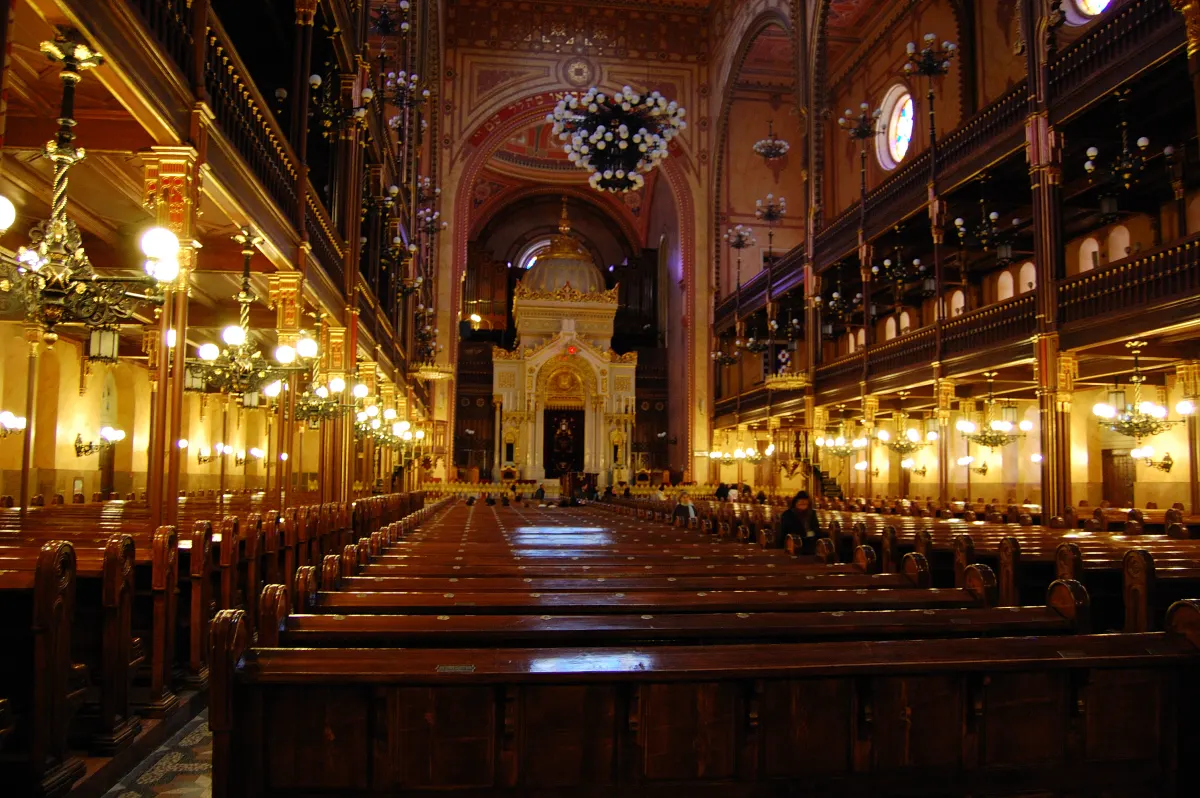
About 200,000 Jews lived in Budapest before the war, and about half were murdered. Enough survived for this to be the largest Jewish community in central Europe today, with working synagogues, kosher bakeries, and a quarter where bars and memorials stand side by side.
Plan around Saturday
The synagogues, museums and the memorial centre are closed on Saturday and Jewish holidays, and shut early on Friday. Sunday is the best day: until the end of 2026 it's the only one when the Rumbach is open as well. Both are closed on 24 and 25 December 2026.
Dohány Street Synagogue
- Europe's largest, with 3,000 seats. 14,500 Ft, students with an ISIC 12,000, children aged 6 to 12 5,500, and under-6s free.
- The ticket includes a 45-minute guided tour, the Jewish Museum, the cemetery of those who died in the ghetto, and Imre Varga's willow tree of steel leaves.
- From 2 November to 31 December 2026: Sunday to Thursday 10 am to 4 pm, Friday to 2 pm. The last entry is an hour before closing. Longer hours were announced from 27 December to 6 January.
- Buy online, at jewishtourhungary.com, to skip the queue. "With guide" tickets at a higher price are the same thing.
- Shoulders and knees covered, or you're turned away. Men are given a kippah. No big bags.
The other synagogues
- Rumbach Sebestyén utca: Otto Wagner's, octagonal, blue and gold, restored in 2021. 5,500 Ft.
- Kazinczy utca: the Orthodox one, Art Nouveau, still in daily use. Open irregularly, and on the operator's Sunday tour.
A walk through the quarter
Two kilometres, about 30 minutes without stops:
- The Dohány synagogue and the garden behind it, seen through the railings on Wesselényi utca.
- The Carl Lutz memorial, Dob utca: the Swiss vice-consul who saved tens of thousands. Raoul Wallenberg's is in the synagogue's garden.
- Gozsdu udvar, a chain of courtyards, now restaurants.
- Király utca 15: a memorial of 2010 on the line of the ghetto wall, in the back yard of a block of flats. Be quiet, as people live there.
- Klauzál tér, the middle of the ghetto, where nearly 70,000 people were shut in during the winter of 1944 to 1945.
- Kazinczy utca: the synagogue, and the ruin bars a few doors on.
- Look down for Stolpersteine, small brass plates outside the houses people were taken from.
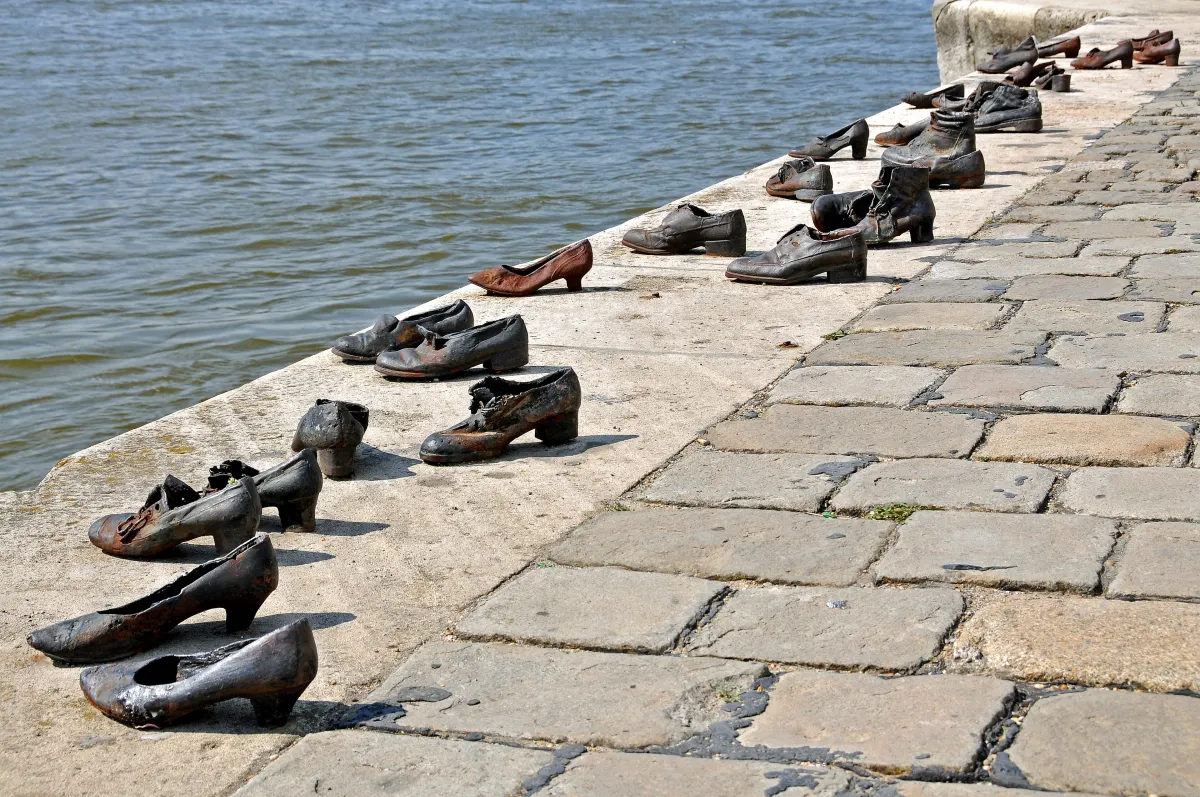
Shoes on the Danube Bank
Sixty pairs of iron shoes on the embankment south of Parliament, for the Jews whom the Arrow Cross shot into the river. Free, at any hour. Come early, when it's empty. Don't put them on, or pose.
Holocaust Memorial Center
- Páva utca 39, near metro Corvin-negyed (M3). 3,600 Ft. Sunday to Friday 10 am to 6 pm, with the desk closing at 5. The courtyard, with its wall of names, is free.
- The exhibition, underground, covers the Roma as well as the Jews, and ends in a restored synagogue. Allow two hours. It's recommended for over-12s.
Elsewhere
- Kozma utca cemetery, by tram 28: grand tombs, one of them by Béla Lajta in turquoise tiles. Closed on Saturday.
- The medieval prayer house on Táncsics Mihály utca, on Castle Hill, from the time when Buda had a large Jewish town.
- The memorial to the German occupation on Szabadság tér, and in front of it the victims' families' own protest of photos and suitcases.
- Outside Budapest: synagogues in Szeged (the finest), Pécs, Tokaj and Mád, and the pilgrims' graves at Bodrogkeresztúr and Sátoraljaújhely.
Kosher food and Shabbat
- There are kosher restaurants, a butcher and bakeries round Kazinczy utca and Dob utca. "Jewish-style" isn't kosher: ask for the certificate. Meals for Shabbat are ordered ahead.
- Flódni, the cake of poppy seed, apple, walnut and plum, is worth a detour. So is sólet, the Sabbath bean stew.
- To join a service, write to the community, and bring your passport for security.
When
The Jewish Cultural Festival is about September. 16 April is Hungary's day of remembrance, and 27 January the international one.

Dohány Street Synagogue, Budapest
The largest synagogue in Europe, built in the 1850s in a Moorish Revival style, with twin onion-domed towers.
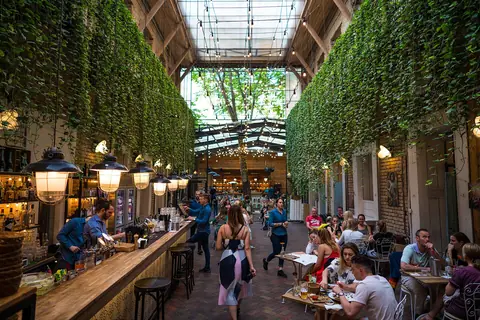
Ruin bars, Budapest
Bars in derelict buildings filled with odd furniture and art, starting with Szimpla Kert, which also has a Sunday farmers' market.
Comments