
Money in Hungary: the forint, exchange offices and cash machines to avoid, cards, prices, shop hours and VAT refunds
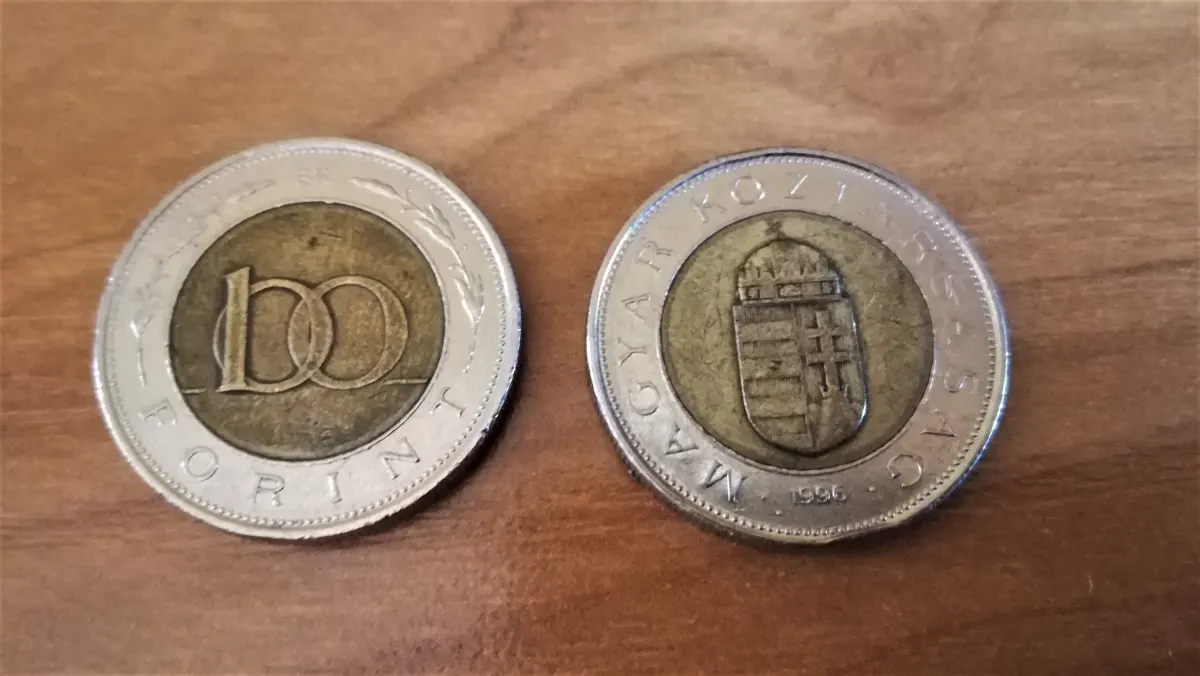
Hungary is in the EU but doesn't use the euro. The currency is the forint (Ft or HUF). The European Central Bank's rates on 23 November 2026 made €1 = 372 Ft, £1 = 445 Ft, US$1 = 340 Ft and A$1 = 225 Ft. It was stronger than in 2025, so old price guides look too cheap. The government says it wants to meet the conditions for the euro by about 2030. There's no date.
Notes and coins
- Notes of 500, 1,000, 2,000, 5,000, 10,000 and 20,000 Ft, and coins from 5 to 200 Ft. Prices in cash are rounded to the nearest 5 Ft.
- All those zeros make it easy to mix up 1,000 and 10,000. Look twice, and watch your change. Old banknotes withdrawn years ago are worthless in shops.
Cards
- Cards and phones work nearly everywhere, and shops have to offer some way of paying electronically.
- If a terminal asks, always choose to pay in forints. Choosing your own currency is a worse rate.
- Cash is for markets, village shops, small cellars, beach stalls, toilets and tips. 10,000 to 15,000 Ft in small notes is enough. The minaret at Eger takes nothing else.
- Some shops and restaurants in the centre accept euros, at a poor rate, and give change in forints.
Cash machines
- Use a machine (ATM or bankautomata) that belongs to a bank: OTP, Erste, CIB, MBH, UniCredit or Raiffeisen.
- The blue and yellow Euronet machines stand wherever tourists do. They offer big sums and a dreadful rate.
- On any machine, refuse the conversion: choose "without conversion" or "charge in HUF", even when the screen makes it look like cancelling.
- Cover your PIN, and prefer one inside a bank.
Changing money
- The worst rates are at the airport, the stations, hotels and on Váci utca: often 10 to 15% off.
- Look for an exchange office (pénzváltó) where the buying (vétel) and selling (eladás) rates are close: a few per cent apart. "No commission" means nothing.
- Some show the good rate in big figures, for large sums only, or for selling, not buying. Ask "How many forints for 100 euros?" before you hand anything over.
- Never change money in the street: see Scams.
What things cost
In Budapest in autumn 2026. It's cheaper in the country, except at Lake Balaton in July and August.
- Espresso 800 Ft. Half a litre of beer 1,200 to 1,600 Ft in a local pub, and over 2,200 Ft in the best-known ruin bar.
- A weekday set lunch (napi menü), soup and a main, 2,400 to 2,700 Ft. Goulash soup 2,900 to 3,100 Ft. Lángos with cream and cheese 3,500 Ft in a market, 5,000 Ft and more near Váci utca.
- A transport day ticket 2,750 Ft. Széchenyi Bath 13,200 to 15,800 Ft. Parliament 7,000 Ft, or 14,000 Ft for those from outside the EEA.
Shops and holidays
- Food shops open from about 6 or 7 am to 8 or 9 pm, and shorter hours on Sunday. Malls are open every day. Others often shut on Saturday afternoon and Sunday.
- Public holidays close nearly all shops: 1 January, 15 March, Good Friday and Easter Monday (26 and 29 March 2027), 1 May, Whit Monday (17 May 2027), 20 August, 23 October, 1 November, and 24, 25 and 26 December. 24 December is new: the law was voted on 3 November 2026.
- Tobacco is sold only in shops marked Nemzeti Dohánybolt. They often sell drinks, and open late.
Bottle deposits
Most bottles and cans carry a deposit of 50 Ft. Put them, uncrushed, in the REpont machine at a supermarket, and take the voucher to the till.
VAT refund
- If you live outside the EU you can get back part of the VAT (27% on most goods) on purchases of more than €175 in one shop: 68,000 Ft in 2026, by the tax authority.
- Ask for the tax refund form, and take the unused goods out within 90 days. Show them to customs with the form and the receipt as you leave the EU, before you check your bag in. Firms such as Global Blue keep a share.
See also Tipping.
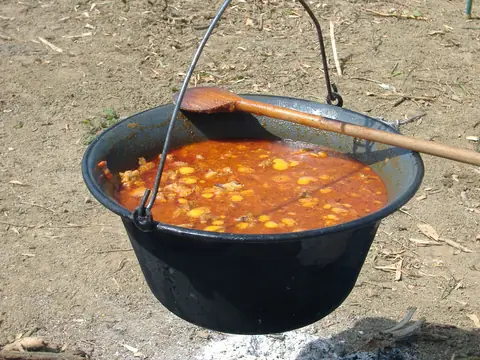
Goulash (gulyás)
Hungary's paprika beef soup with potatoes and peppers, originally herdsmen's food cooked in a kettle.

Lángos
Deep-fried flatbread with garlic, sour cream and grated cheese, a beach and market snack.

Comments