
Historic sites
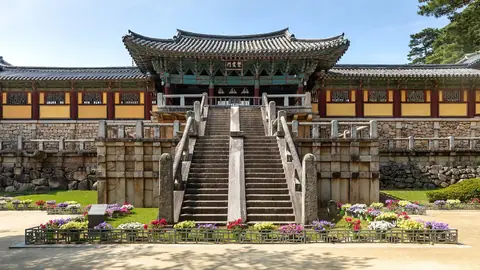
Bulguksa Temple and Seokguram, Gyeongju
Gyeongju, North Gyeongsang
Gyeongju was the capital of the Silla kingdom for nearly a thousand years and is called 'the museum without walls'.
Gyeongju was the capital of the Silla kingdom for nearly a thousand years and is called 'the museum without walls'.
The grandest of Seoul's five royal palaces, built in 1395 for the Joseon dynasty, set against the mountains.
A volcanic island off the south coast, a UNESCO World Heritage Site, with Hallasan, South Korea's highest mountain (1,947 m), lava tubes such as the …
A hillside neighbourhood of traditional Korean wooden houses (hanok) with tiled roofs, between Gyeongbokgung and Changdeokgung palaces.
The heavily fortified border strip between North and South Korea.
A hillside neighbourhood of brightly painted houses stacked up the slopes above Busan's port, once a refugee settlement, now full of murals, art inst…
One of the oldest and largest traditional markets in Korea, opened in 1905, with rows of food stalls where you sit on benches to eat bindaetteok (mun…
A traditional village of tiled and thatched houses in a bend of the Nakdong River, still lived in by the Ryu clan, a UNESCO World Heritage Site.
South Korea's most famous mountain park, with granite peaks, waterfalls and temples, especially spectacular in autumn.
A fortress wall built in the late 18th century around the centre of Suwon, nearly 6 km long, with gates, watchtowers and bastions, a UNESCO World Her…
Many Buddhist temples in Korea offer templestays of one or two nights, where you join monks for early morning chanting, meditation, a tea ceremony an…


